
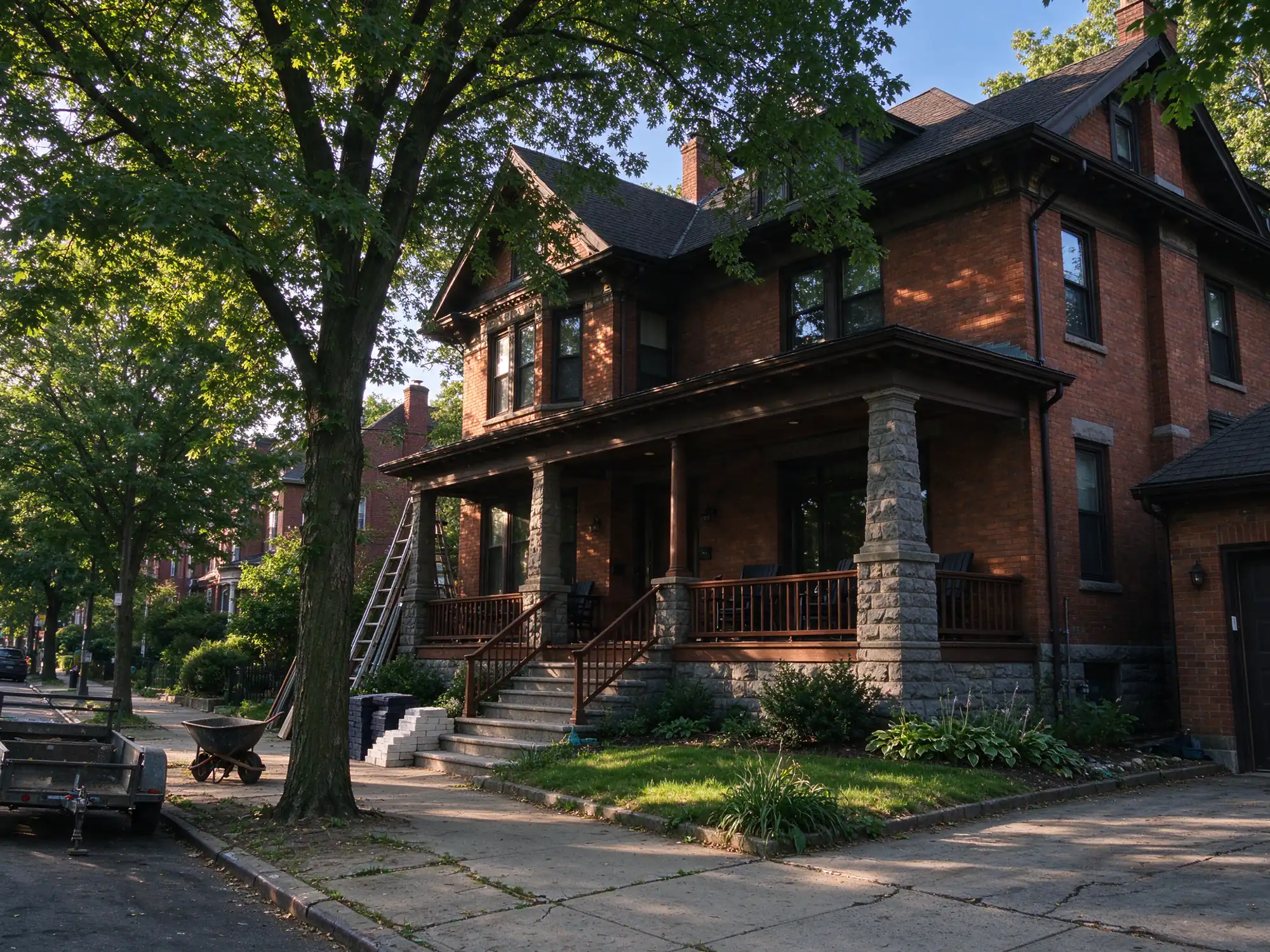
True Course Masonry Newark repairs brick, stone, chimneys and front steps on houses in Forest Hill, in Newark’s North Ward. Masonry in Forest Hill, Newark starts with paperwork more often than with a trowel. The district sits under the city’s historic review, so the scope has to show what the commission will want to see before anyone cuts a joint. The work is fulfilled by licensed and insured contractors, and small repairs are welcome, from a few stones to repointing a whole elevation.
Approval first, or scope first?
Scope first, then approval, then the start date. Newark’s historic review looks at what the work will change, so it needs a written description of materials, mortar color and joint profile before it can respond. A first look checks the wall type, joint depth, brick or stone condition, earlier repairs, water sources, movement clues and access, and the written scope that follows names each area. Where appearance matters, a mortar trial area is made and left to cure so the match can be judged dry. The guide to masonry permits in Newark covers the construction permit side, which runs through the Newark construction office separately from historic review.
Historic masonry restoration and stone masonry repair are the usual scopes on older Forest Hill houses, with stoop repair and chimney repair for steps and stacks. The guide to lime mortar and portland cement explains why a softer mix is often the better choice on old masonry, and the guide to brownstone repair and matching covers sandstone trim. On a larger house, a chimney can rise well above a steep roof, so access for the stack is planned in the scope as its own line, and a stack that leans or has lost brick is viewed from the ground or a lift rather than climbed on to judge it.
Why Forest Hill is different from the rest of Newark
Historic review is the first difference. Newark’s Landmarks and Historic Preservation Regulations, Chapter 41:10, adopted in November 2023, give the Landmarks and Historic Preservation Commission power to issue Certificates of Appropriateness in historic districts, with a Historic Preservation Officer able to issue Certificates of No Effect, and Forest Hill is one of the city’s seven designated districts. The Forest Hill Historic District was added to the National Register on August 3, 1990, and is roughly bounded by Verona Avenue, Mount Prospect Avenue, Second Avenue and Branch Brook Park. Wikipedia’s account of the neighborhood describes large single-family houses in styles from Queen Anne and Colonial Revival to Spanish Revival and Craftsman, so masonry here often means chimneys, stone trim and front steps on bigger houses rather than the party walls of the Ironbound.
Ground is the second. The Newark Public Library notes that the city’s terrain rises to the north and west, with slopes above 200 feet in Forest Hill near the Belleville border. On a lot that sits above the street, front steps run taller, and rain moving downhill reaches the steps and the base of the walls, so drainage at grade is checked alongside the masonry. Retaining walls themselves are not offered. Owners just over the line can see the Belleville and Bloomfield pages.