
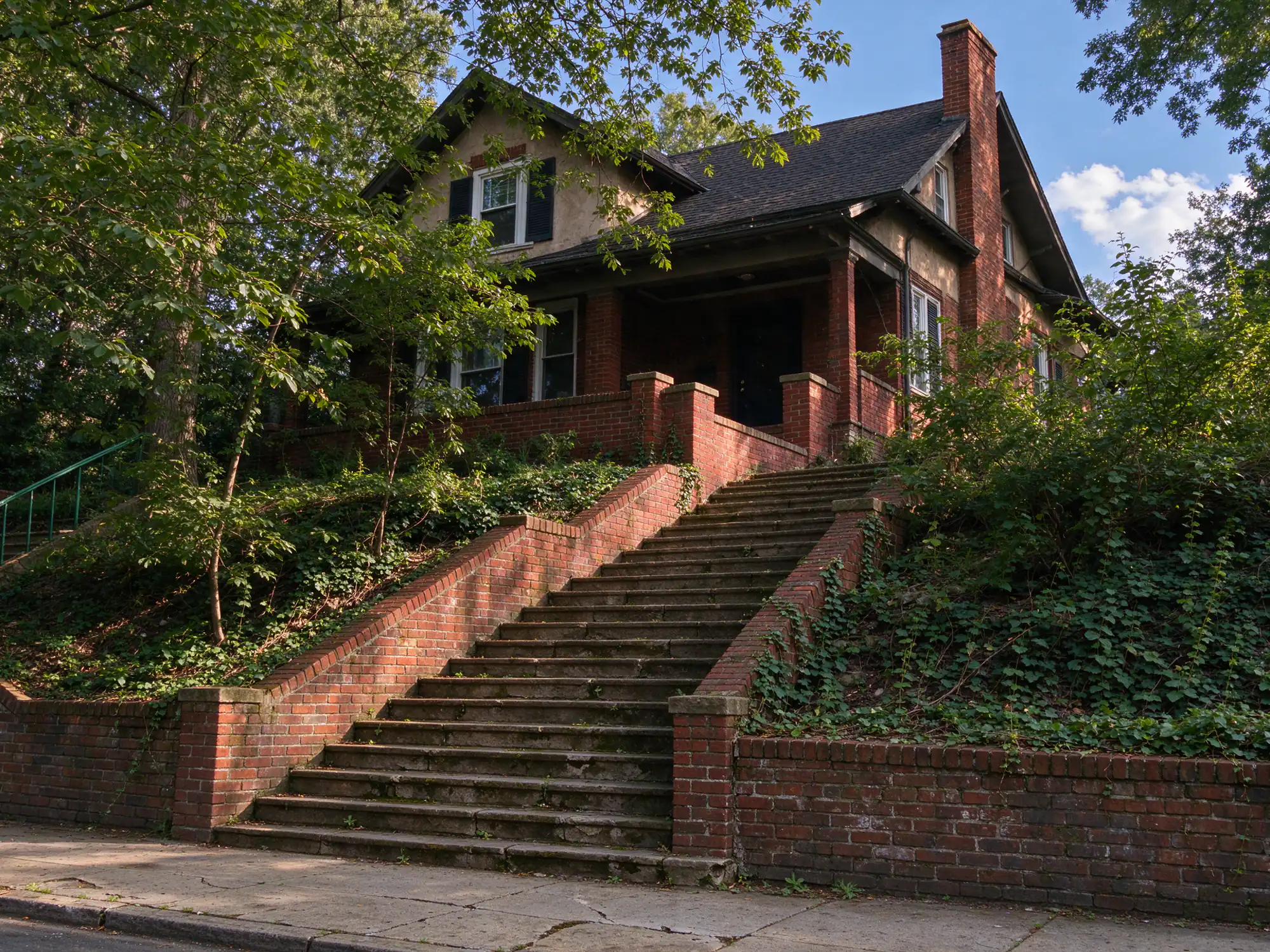
True Course Masonry Newark repairs front steps, stoops, stone and brick walls and chimneys on West Orange houses, working through licensed and insured contractors and taking jobs of every size. West Orange climbs First and Second Watchung Mountains, and on a hillside lot the masonry that fails first is usually the long run of steps and cheek walls between the street and the front door. That is where most West Orange masonry questions start.
Why hillside steps fail first in West Orange
On a steep lot, the entry steps do the work a short stoop does on a flat street, only more of it. A long run of steps has more joints facing the sky, more treads holding water and cheek walls that carry soil on one side. Water runs down the slope and along the steps, settles into open joints and freezes there. NOAA’s 1991 to 2020 normals for Newark Liberty Airport, the nearest long-term station, record about 65 days a year when the low falls to freezing and the high climbs above it, and every crossing works on water that is already in the joints.
The usual pattern is joints opening at the top of each riser, then treads rocking, then a cheek wall cap coming loose. At that stage the repair is resetting and repointing. When the steps have dropped away from the house, or a crack runs straight through treads and joints alike, the cause may be below the masonry, and the guide to when a masonry crack needs an engineer sets out the signs. The guide to stair-step cracks explains what diagonal cracking through brick usually means.
West Orange regulates steep slopes through Chapter 25-28, its Steep Slope and Natural Features Ordinance, which counts 10% as steep and 25% as excessively steep and limits how much of such ground can be disturbed. It applies to development applications and permits that involve grading or clearing, and it exempts existing single-family homes, so repairing steps in place on an existing house is generally outside it. Where a slope needs holding back, retaining walls are a separate trade and are not offered; the code requires an engineer’s certification and a variance for walls over four feet.
Services for West Orange houses
Stoop repair covers brick and stone front steps, cheek walls, caps and treads, and the guide to stoop repair cost explains what moves the price. Stone masonry repair handles stone walls, piers and foundations, and brick repair handles spalled or cracked brick on walls and porches.
Chimney repair covers repointing, brick replacement and crowns, and chimney rebuild applies when a stack has lost too much brick above the roof to repoint. The guide to chimney crown cracks explains why a crown is usually the first thing to fail on a tall stack. Flue liners and sweeping are not offered.
On a designated landmark or an older house where appearance carries weight, historic masonry restoration adds mortar matching, joint profile matching and careful unit replacement.
Landmark review in West Orange
West Orange’s Historic Preservation Commission, established in 1992 and governed by Section 25-30 of the township code, has binding review over designated landmarks. A Certificate of Appropriateness is required before the Construction Official or Zoning Officer issues a permit for a change in exterior appearance, including rehabilitation, reconstruction, replacement and even maintenance, and the only repair exemption is ordinary repair under $500 that is an exact replacement. Its standards are the Secretary of the Interior’s: repair rather than replace, match material in composition, design, color and texture, and do not sandblast.
The list is short. The code names eight landmarks, among them the Llewellyn Park Gate House and the Edison National Historic Site, and the township’s commission page refers to ten. There are no local historic districts, so most West Orange houses, including those in the Llewellyn Park National Register district, are not under the commission unless the property itself is designated.
Matching West Orange’s older brick and stone
The township’s best-documented buildings show how varied local masonry is. National Park Service records for Glenmont, Thomas Edison’s home, describe a basement of bluestone blocks, a first story of pressed brick trimmed in freestone and paneled brick chimneys under a slate roof. The 1887 Edison laboratory buildings have brick walls, and the Park Service notes Edison specified hard-burnt New Jersey brick, with a different face brick on the Valley Road front. The 1857 Llewellyn Park Gate House is random-laid sandstone and bluestone, and in 2020 the New Jersey Historic Trust granted $150,000 toward its preservation, including repointing.
Houses on the same streets mix those materials too. Bluestone, sandstone and brick each want a different mortar and a different repair, so the stone or brick is identified before any patch or mix is proposed. The age profile backs that up: American Community Survey figures for 2020 to 2024 show 24.8% of West Orange housing units were built in 1939 or earlier and 59.4% before 1960, and older walls were often laid in softer, more lime-rich mortar than modern mixes.
How a West Orange job is planned
A first look starts at the street and walks the steps to the door, checking joints, treads, caps and cheek walls, how water drains across them and whether anything has moved. On a chimney it checks the crown, the brick and the flashing line. The property is checked against the township’s landmark list, then the permit goes through Building and Construction Code Enforcement at 66 Main Street; N.J.A.C. 5:23-2.14 requires a permit to repair or reconstruct a structure unless an exception applies. New Jersey requires home improvement contracts over $500 to be in writing with the contractor’s registration number. Owners nearby can also see the Orange, Montclair and South Orange pages.