
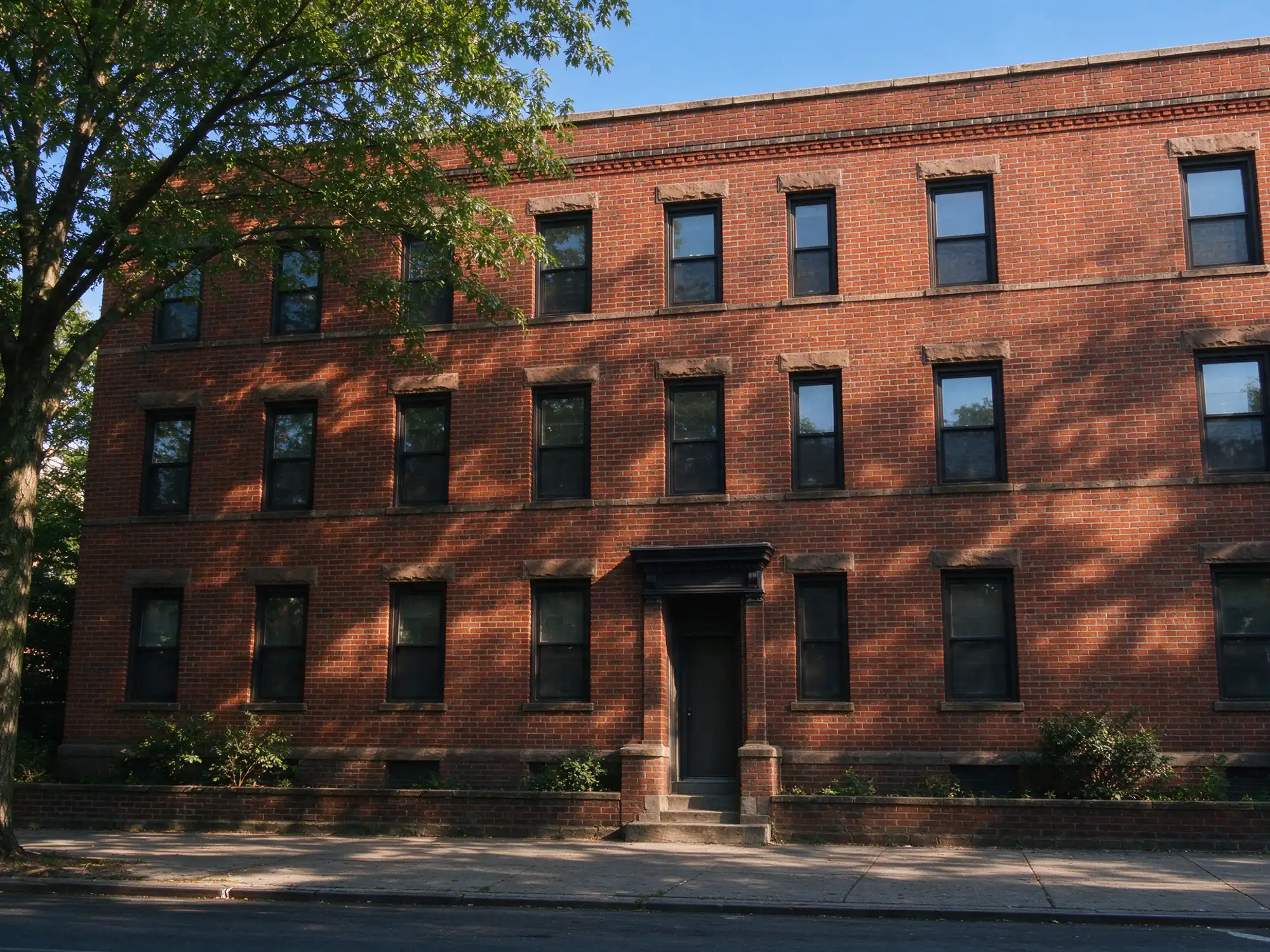
True Course Masonry Newark repairs brick walls, parapets, lintels and mortar joints on East Orange apartment buildings, two-family houses and storefront buildings. The work is fulfilled by licensed and insured contractors, and the business takes masonry jobs of every size, from a few replacement bricks under one window to repointing a full street elevation. East Orange shares a border with Newark’s west side, but its building stock puts different questions to a mason, and the sections below explain what those questions are and how they change the work.
What East Orange masonry is up against
U.S. Census Bureau American Community Survey figures for 2020 to 2024 describe a city of apartment buildings. Of East Orange’s 29,921 housing units, 49.3% sit in buildings with five or more units, against 36.0% in Newark and 19.8% of East Orange units that are detached houses. The stock is also old: 32.1% of units were built in 1939 or earlier and 55.2% before 1960. The ACS does not record wall material, so these numbers do not say how many of those buildings are brick. Where a prewar apartment building is brick-faced, though, its form concentrates masonry risk in a few predictable places.
A flat-roofed apartment building usually ends at a parapet, a short wall that rises above the roof line and is open to weather on both faces and the top. Its coping is a horizontal wash surface, and a single open coping joint can feed water down into the wall below. A street elevation four or five stories tall may carry dozens of window openings, and every one of them has a lintel or arch carrying the brick above it. Where buildings stand close together or share a wall, the side and rear elevations may only be reachable from a neighbor’s lot or a narrow passage. And where the front wall sits at the sidewalk, any work above the first floor raises the question of protecting the people walking beneath it.
For an owner, the scale changes the decision. A repair choice on a 40-unit building covers 40 households, and a staged program across several elevations is often a better fit than one large mobilization.
Services that matter most on East Orange buildings
Parapet repair comes first on many flat-roofed buildings because the parapet is the most exposed masonry on the building. Loose copings, open joints and brick that has lost its face at the top of the wall get assessed together with the roof flashing they meet, since a leak at the top-floor ceiling can start at either.
Lintel replacement matters when a facade has rows of openings. Where a steel angle spans the opening and rusts, the growing rust can lift the brick above it and open stepped cracks at the window corners. Repointing those cracks without dealing with the steel hides the cause; the guide to cracks above windows explains how to read them.
Brick pointing on a multi-story wall is real joint removal and replacement, not a skim of new mortar over old. On older brick, the new mortar is chosen to suit the existing brick and mortar rather than defaulting to the hardest mix available.
Commercial masonry repair covers mixed-use frontages and larger apartment buildings where scaffolding, occupied-building staging and pedestrian protection drive the plan as much as the masonry does.
Brick repair handles localized unit replacement: spalled bricks, a section around a failed downspout, or damage near a doorway. Matching older brick and reaching it at height set most of the cost.
Chimney repair applies mostly to the city’s two- to four-family houses and detached homes, which together hold close to half of East Orange’s units. Flue liners and sweeping are not offered.
How an East Orange job usually runs
A first look identifies the wall assembly where it can be seen (solid multi-wythe brick, veneer or block backup), the condition of joints and units, copings and openings, the likely water sources and the access the job will need. That checklist shapes the scope; it is not a structural diagnosis, and bulging or displaced walls can call for an engineer.
Permits run through East Orange’s own construction office, which is separate from Newark’s. Under N.J.A.C. 5:23-2.14, repairing or reconstructing a structure needs a permit unless an exception applies, and the state’s ordinary-maintenance list contains no masonry or repointing item. The minor-work path in 5:23-2.17A is written for one- and two-family dwellings, so it does not describe work on an apartment building. New Jersey’s 2024 code editions took effect on August 17, 2026, with a reported grace period. Whether a given East Orange job needs a permit is confirmed with the East Orange construction office for that address.
Access is planned before the start date. Where facade work could threaten the public sidewalk, N.J.A.C. 5:23-2.34 calls for sidewalk or street bridging designed by a design professional and signed off before that work begins. East Orange’s own sidewalk-occupancy and container rules were not researched for this page, so they are checked with the city before staging. Joint cutting creates dust and debris, so entrances, windows and the sidewalk below get protection plans that keep the building usable while work is underway.
Why the same crack means something different here
Weather is a countywide condition, not an East Orange one. NOAA’s 1991 to 2020 normals for Newark Liberty Airport, the nearest long-term station, show 79.9 days a year with a low at or below freezing but only 14.5 days with a high that stays there, so roughly 65 days cross the freezing mark. That is a proxy, not a measured cycle count, and it sits alongside 46.60 inches of annual precipitation. On a parapet, both faces and the top take that wetting, so saturated brick and open coping joints face freezing conditions from more sides than a ground-floor wall does.
The housing form is what is specific to East Orange. With about half of all units in buildings of five or more, a problem at the top of one wall can show up as a leak in an apartment several floors from where it started, and the repair decision sits with a building owner or manager rather than a single household. The NJ Department of Community Affairs Construction Reporter shows about $30.9 million in residential additions and alterations authorized by East Orange permits in 2024, though that data has no work-description field and says nothing about masonry specifically.
The contrast with neighbors is sharp. Newark’s largest share, 40.6% of units, is in two- to four-unit buildings, where stoops, chimneys and house-scale repointing dominate. Glen Ridge is 85.5% detached and 81.1% built before 1940, and its Historic Preservation Commission reviews street-visible exterior changes that need a building permit; Montclair’s commission issues Certificates of Appropriateness in its districts. This research found no evidence either way about East Orange historic review, so that is confirmed per address, while height and access remain the defining questions here.
Why this approach fits East Orange buildings
Scopes are written from what the first look finds, so a building gets a lintel and coping plan when that is the problem rather than a whole-facade repointing it does not need. Small repairs are taken as readily as large ones. Work is fulfilled by licensed and insured contractors, and New Jersey law requires home improvement contracts over $500 to be in writing with the contractor’s registration number and insurance certificate; the guide to hiring a masonry contractor in New Jersey covers what else to check. For timing, the guide to masonry work in cold weather explains why NOAA’s median first fall freeze of November 10 matters for curing mortar, and the brick pointing cost guide breaks down what moves the price.
Owners with buildings across the line can also see the pages for Orange, Irvington and Bloomfield.