
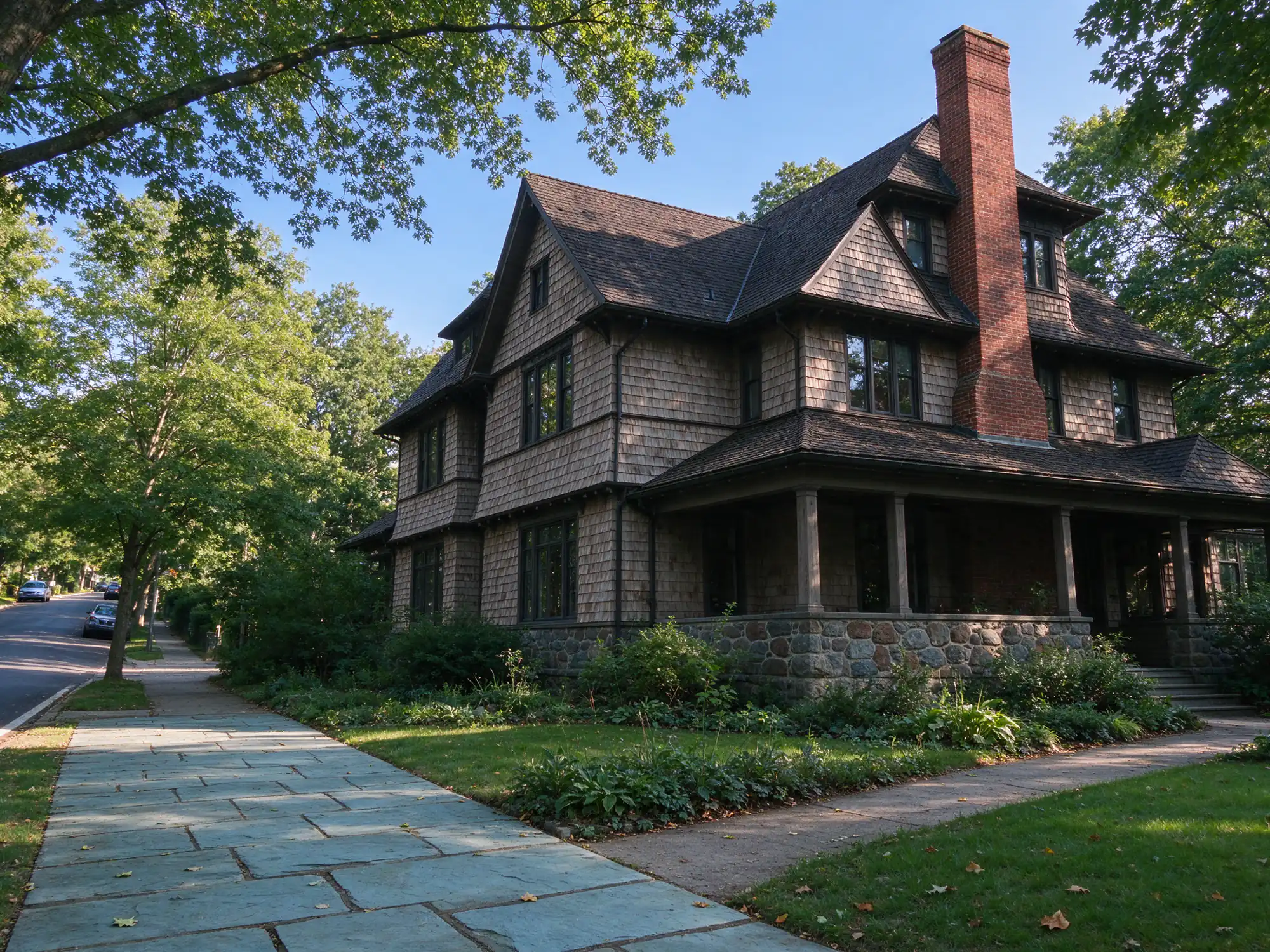
True Course Masonry Newark repairs chimneys, stone foundations, front steps and brick on older South Orange houses, through licensed and insured contractors, on jobs of every size. In South Orange Village the first question on a visible masonry repair is often not price but review: on the designated Montrose Park houses, work that changes how a facade looks needs the Historic Preservation Commission before the Building Department issues a permit. Matching the existing mortar, brick and stone is what keeps most repairs on the simpler side of that line.
When South Orange’s preservation ordinance applies to masonry
South Orange set up its Historic Preservation Commission under the state’s Municipal Land Use Law in 2012, and in September 2024 the village restated the rules as Chapter 9 of its code through Ordinance 2024-16. Under those rules, a Certificate of Appropriateness is required for demolition, relocation or major work on a contributing structure in a designated historic district or a designated local landmark, and major work includes any change to a publicly visible facade. The Commission’s decision on a certificate is binding, with appeals going to the Zoning Board of Adjustment within 45 days.
Masonry is named directly. The ordinance lists painting previously unpainted brick and stone as minor work, which a two-member subcommittee decides within 15 days. Its demolition by neglect section covers deterioration of exterior walls, chimneys, brick, plaster and mortar. On the other side, repair and maintenance of less than 25% of a building component using the same style and materials is listed as exempt, as is in-kind repair of driveways and sidewalks.
Coverage is narrower than the district map suggests. The Commission’s October 2024 guidance says the only designated residential properties at that time were the 40 key contributing properties in the Montrose Park Historic District, with more contributing houses under consideration as local landmarks. The ordinance does not say whether repointing or a chimney rebuild counts as minor or major work, so for a designated house any repair that would look different from the street is raised with the Commission first, and the guide to matching mortar and brick explains what makes a repair read as in kind.
Services that fit South Orange houses
Most South Orange houses are wood-framed, so masonry here is usually the chimney, the foundation, the front steps and garden walls rather than whole walls.
Chimney repair covers repointing the stack, replacing spalled brick and replacing a cracked crown. A stack that leans or has lost brick above the roof may need a chimney rebuild instead; the guide to rebuilding or repointing a chimney explains where that line falls. Flue liners and sweeping are not offered.
Stone masonry repair suits fieldstone foundations, stone piers and stone garden walls, and stoop repair covers brick and stone front steps that have settled or lost their joints. Brick pointing handles brick side walls, porch piers and foundations.
On a designated Montrose Park house, historic masonry restoration brings mortar matching, joint profile matching and selective unit replacement into the scope from the start. The guide to lime mortar and portland cement explains why a hard modern mix can harm old brick and stone.
How a South Orange job is planned
A first look records the material and condition of the masonry, the depth of failed joints, earlier patches, where water reaches the wall and any movement. On a chimney it also checks the crown and the flashing line, because a stain beside the stack can come from flashing rather than brick. Where the color of new mortar matters, a small trial area is mixed and left to cure so the match can be judged dry.
The address is then checked against the village’s designations. If the house is a designated property and the repair would change what the street sees, the Commission comes before the permit. Permits come from South Orange’s Building and Code Enforcement Department at Village Hall on South Orange Avenue. N.J.A.C. 5:23-2.14 requires a permit to repair or reconstruct a structure unless an exception applies, and a chimney rebuild counts as reconstruction. New Jersey’s 2024 code editions took effect on August 17, 2026.
What makes older South Orange masonry different
The housing is old. U.S. Census Bureau American Community Survey figures for 2020 to 2024 show 43.5% of South Orange’s housing units were built in 1939 or earlier and 68.1% before 1960, against 23.7% built before 1940 in Newark. Brick and stone of that age were usually laid in softer, more lime-rich mortar than today’s bagged mixes, and where that holds, a much harder repointing mortar can push water and stress into the units so that the brick or stone fails instead of the joint.
The stone is old too. The Stone House by the Stone House Brook on South Orange Avenue, listed on the National Register in 1991, has walls of native rubble stone dating from before 1680, enlarged in the late 1700s with the same kind of stone. Montrose Park’s sidewalks and curbs are bluestone. Rubble walls and old stone joints depend on mortar that gives way before the stone does, which is why repairs are matched to the existing stone, not to a default bag.
The land rises to the west. The village’s western neighborhoods sit on the eastern slope of South Mountain, where houses were terraced into the hillside, so front steps run tall and water crosses yards toward foundations. Retaining walls are a separate trade and are not offered. NOAA’s 1991 to 2020 normals for Newark Liberty Airport record about 65 days a year when the low falls to freezing and the high climbs above it, and each of those crossings works on water that open joints and cracked crowns let in. The guide to cleaning brick without damage covers why aggressive cleaning makes that worse on old masonry.
Why this approach suits South Orange
Scopes follow what the house has. A sound chimney with a cracked crown gets a new crown, not a rebuild, and loose stones at a front step can be reset without a larger job attached. New Jersey requires home improvement contracts over $500 to be in writing with the contractor’s registration number and proof of insurance. Owners on the township lines can also see the Maplewood, Orange and West Orange pages.