
Last Updated:
Stone masonry repair in Newark, NJ covers a wide range of materials, and each one fails in its own way. True Course Masonry Newark repairs brownstone fronts, stone trim, stone steps and sills, stone foundations, garden walls and stone veneer across Newark and Essex County, with the work carried out by licensed and insured contractors. Small jobs are welcome, from one cracked sill to a single loose cap. The starting point is always the stone itself: a layered sandstone, a dense granite and a cast concrete veneer look similar from the sidewalk but take water, salt and frost very differently, so they cannot be repaired with one method. On older buildings, the mortar matters as much as the stone, which is why the guide to lime mortar vs portland cement is a useful companion to this page.
What happens on the first visit
A first look at stone work sets out what the stone is, how it was laid and why it is failing. Those three answers decide whether the job is repointing, patching, resetting or replacement. The visit checks:
- Stone type. Brownstone, limestone, granite, bluestone, fieldstone or a manufactured product, and whether the stone is full-depth or a thin facing.
- Bedding and condition. Which way the layers run in sedimentary stone, and whether faces are sound, scaling, cracked or peeling in sheets.
- Joints. How wide and deep they are, what the old mortar is like and whether earlier repairs used hard cement.
- Earlier patches. Cement skims or coatings on the stone face that may be trapping moisture.
- Water sources. Gutters, sills with no drip, open joints on caps and copings, splashback at grade and downspouts.
- Movement. Stones that have shifted, caps that have slid, cracks running through several units, or a wall that leans. Those point to a different repair, and the guide on when a masonry crack needs an engineer explains when that is the next step.
- Access. Height, scaffold or lift needs, and how close neighboring buildings stand.
Please do not pry at loose stone or stand beneath a stone that looks displaced. The masonry damage assessment can help you describe what you see before a visit.
Newark brownstone and why it delaminates
Brownstone is the stone most associated with this city, for good reason. The Newark Public Library’s Knowing Newark history describes it as a red-brown arkosic sandstone of the Passaic Formation, part of the Newark Basin, quarried in Newark from about 1700 and used for Old First Church and the front of the Plume House on Broad Street. The New Jersey Geological Survey’s 2012 circular on New Jersey brownstone names the quarries near Newark, around Belleville, as the most productive source of brownstone-front stone in the country. Homes in Belleville and Bloomfield stand near where much of it was cut.
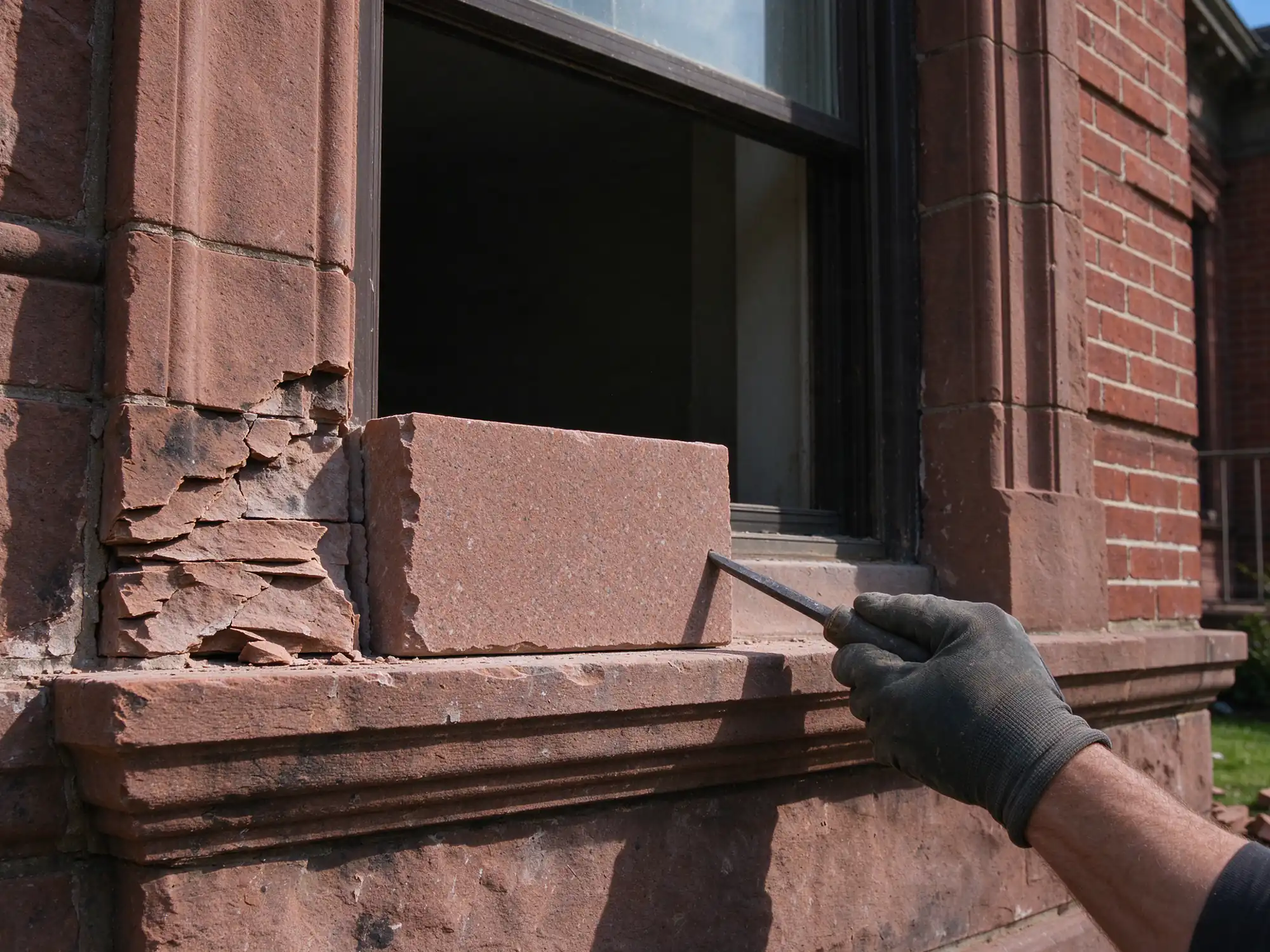
Why it peels. Sandstone is made of sand grains laid down in layers. It holds up best when it is set the way it formed, with the layers lying flat. Facing stone was often cut in slabs and set on edge, with the layers standing upright and parallel to the wall face, which masons call face-bedding. Water then enters along the layers. Salts crystallize between them and freezing water wedges them apart, so the outer layer lifts off in a sheet while the stone behind stays sound. Hard, dense patches and cement-rich mortar speed this up, because water that cannot leave through the joint leaves through the stone next to it.
Patching mortar. For shallow loss, loose layers are cut back to sound stone and the face is built back with a patching mortar formulated for sandstone. It goes on in layers, is anchored where the patch is deep, and is tinted and textured to sit with the stone around it. A good patch is designed to be weaker and more porous than the stone, so that if anything gives in the future, it is the patch. Patching is not a skim over peeling stone; a skim on unsound layers falls away with them.
Dutchman repairs. When a defect is deeper but limited, a section of stone is cut out to clean, square edges and a piece of matched stone is fitted and set in its place. A dutchman keeps most of the original unit while putting real stone where the damage was.
Substitute or salvaged stone. The NJ Geological Survey notes that brownstone fell out of favor, and it has not been commercially quarried in Newark or Belleville for more than a century. A stone that has to be replaced therefore gets either salvaged brownstone, where suitable pieces can be found, or a sandstone from another quarry chosen for color, grain and porosity, not color alone. The brownstone repair and matching guide goes through how each route is chosen.
Limestone, granite and bluestone trim
Limestone trim on rowhouses
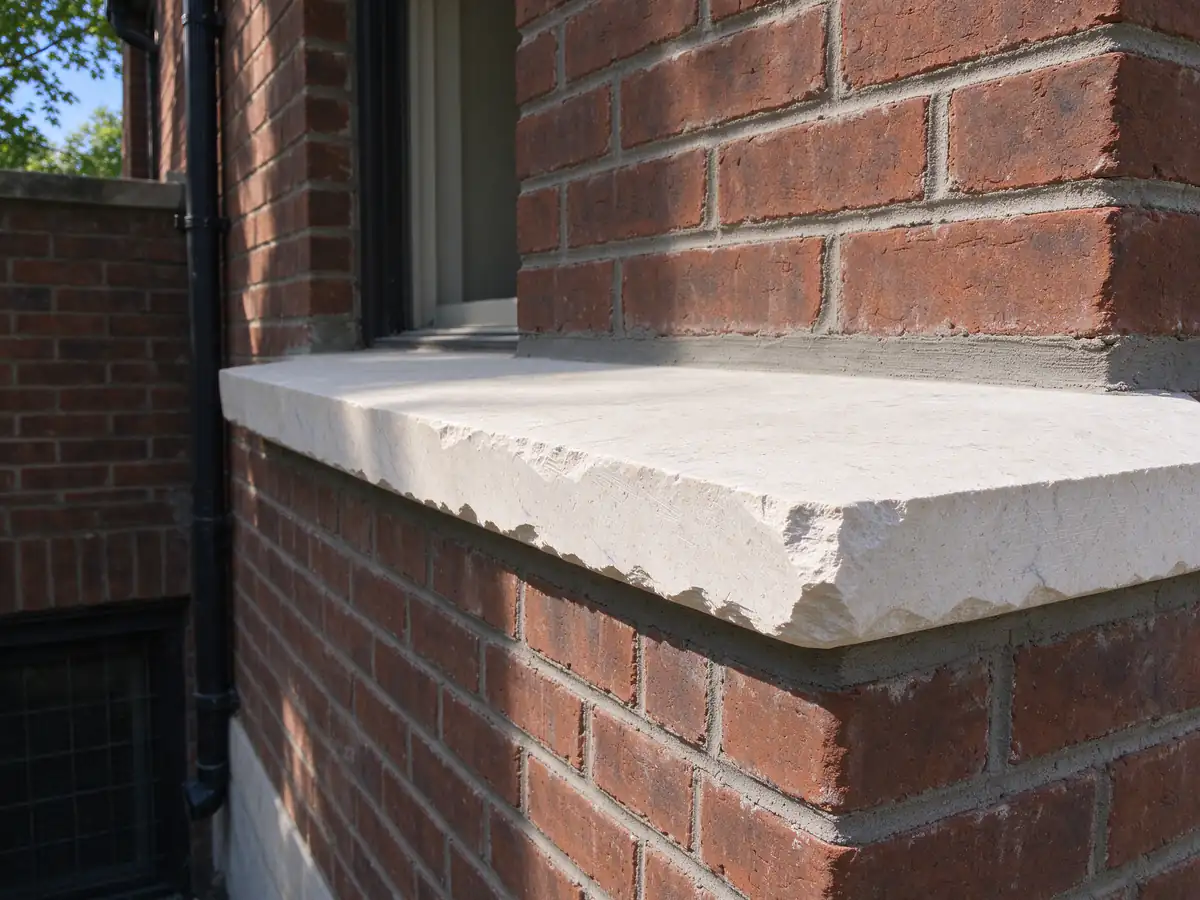
Limestone shows up as window heads, sills, belt courses and carved trim set into brick. The North Broad Street Historic District in the North Ward includes an eight-house block of rowhouses from about 1890 to 1893, seven of them in Renaissance Revival style dressed with limestone. Limestone is a calcium carbonate stone, softer than granite, and it weathers by slowly losing its surface and carved detail where water runs across it. Its joints and any cement patches need the same compatibility thinking as brownstone, and cleaning it calls for the gentlest method that works, tested first. The guide to cleaning masonry without damage covers why harsh acids and high-pressure water are a poor match for soft stone.
Brownstone trim, lintels and sills
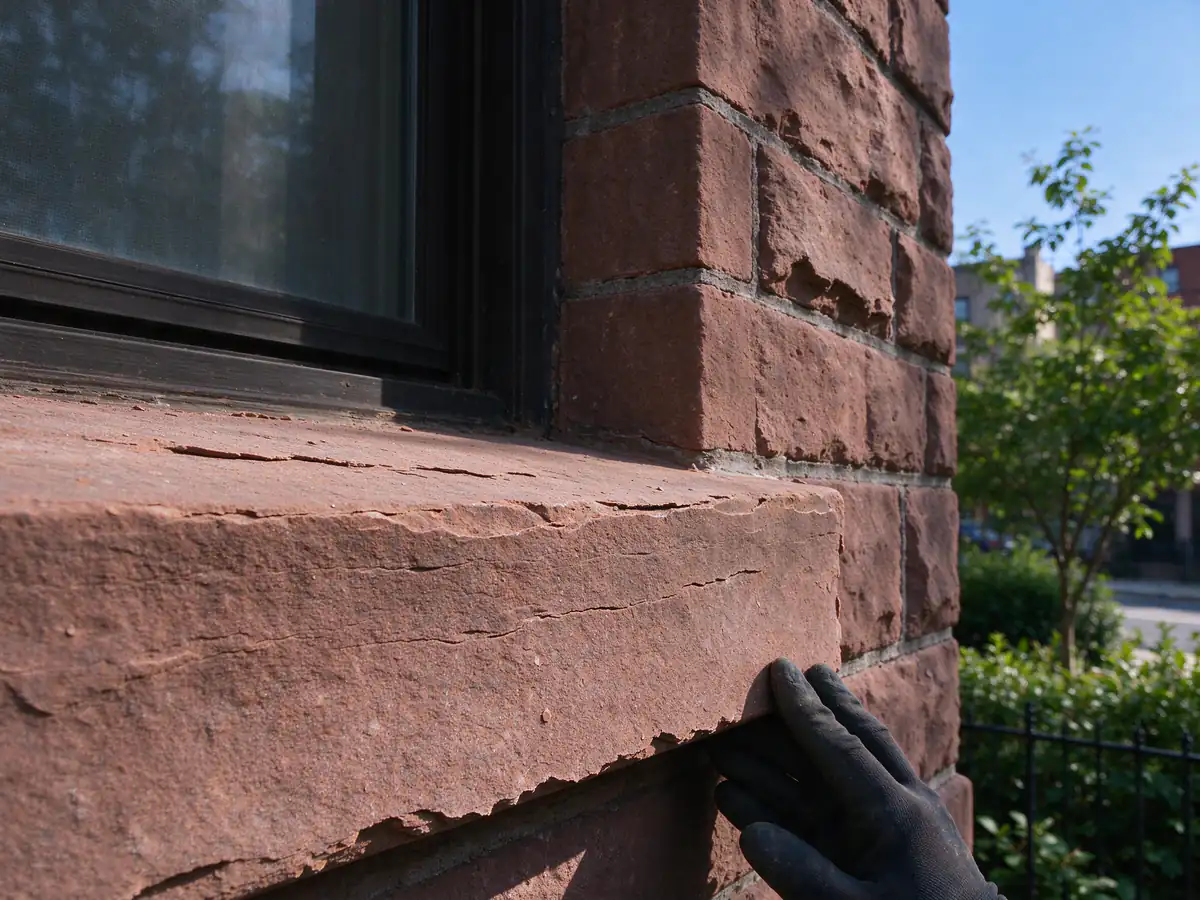
On many brick buildings the stone is decorative: brownstone or limestone sills, window lintels, keystones and quoins. Sills take water on their top face and drip it off the front edge, so a sill that has lost its slope or drip, or cracked through, sends water into the wall below. A stone lintel that has cracked over an opening is a different repair from one with spalled corners, because a crack through the lintel affects how the wall above is carried. Where a house has steel angles carrying brick over openings instead, the steel lintel replacement page covers that work.
Granite and bluestone steps, sills and curbs
Where a house has granite steps, sills or curbing, or bluestone treads and sills, the stone itself is usually durable and the failures sit around it: joints washing out, units shifting on a failed bed, and cracks where a slab spans unevenly. Bluestone is a layered sandstone too, so a tread can split along its layers if water gets into an edge. Most of that work is resetting and repointing; the stoop and step repair page covers stone stoops in full.
Stone walls, foundations and veneer
Coursed and rubble stone
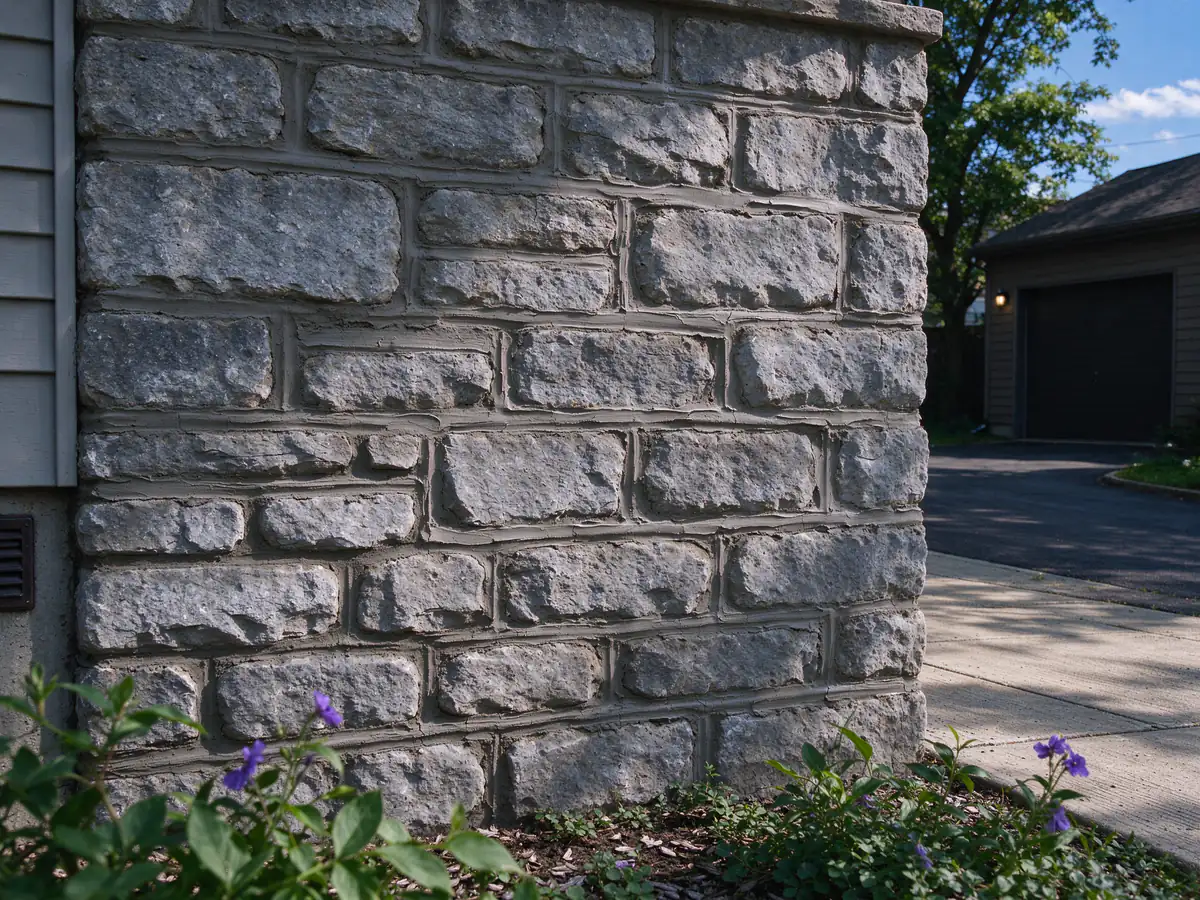
Coursed stone is cut to fairly even heights and laid in level rows; rubble stone is irregular and laid to fit, with joints that change width from stone to stone. Repointing a rubble wall means following every joint by hand, filling deep voids in stages and tooling the face to the old look, often a slightly recessed joint that lets the stone read. Overfilled, smeared joints on rubble change its appearance and hold water against the stone edges. Repointing stone otherwise follows the same rules as brick: failed mortar is cut to sound material and replaced, as described on the brick pointing page.
Stone and brick foundation repointing
Older stone foundations were commonly laid in lime-rich mortar that washes out over time, especially where soil, downspouts or splashback keep them wet. Repointing the exposed faces with a compatible mortar restores the joints and helps the wall shed water. That is masonry maintenance, and it is in scope. A foundation that has cracked through, bowed or settled is a structural matter for a foundation repair specialist, which is a separate trade not offered here. Setting a new window or patching around a pipe in an old stone foundation raises the same mortar question; the guide on matching mortar and brick explains why a cured trial area helps.
Resetting loose stone and caps
Copings, wall caps, stoop caps and newel blocks are flat stones that take the worst weather. When their mortar bed fails they rock or slide, and water then runs straight into the wall below. Resetting means lifting the stone, cleaning the bed and the stone’s underside, checking that the masonry underneath is sound, and relaying it with the right slope and drip. Stones that are loose because the wall beneath has moved are a different job, and the guide to a bulging masonry wall explains the warning signs.
Natural vs manufactured stone
Natural stone laid in mortar is a masonry unit like brick: it absorbs water and dries through its faces and joints. Manufactured stone veneer is cast concrete that is adhered, not laid, to a backing with a water-resistive barrier, lath and a setting bed, and it depends on flashing and a weep screed at its base to let water out. When natural thin stone veneer delaminates, it is often the stone or the bond to the backing that has failed; when manufactured veneer comes loose or stains, the cause is often water trapped behind it. Repairs to adhered veneer usually mean removing the affected area to see the backing. The comparison table on this page sets the two side by side.
How stone repair differs from brick repair
Brick is a uniform manufactured unit; stone varies by quarry, bed and even block. Replacing a brick means finding a match in size, color and hardness. Replacing a stone can mean cutting a new piece to the opening, which is why stone repairs lean toward patching, dutchmen and resetting before replacement. Stone joints are also less regular. For brick faces that have spalled, the brick repair page covers that route.
Permits, historic districts and access
New Jersey’s Uniform Construction Code, N.J.A.C. 5:23-2.14, requires a permit before repairing or altering a structure, with exceptions for ordinary maintenance, minor work and emergency work. The ordinary maintenance list in N.J.A.C. 5:23-2.7 does not name repointing or stone repair and excludes work affecting structural safety, so ask the Newark construction office before work starts. The guide to masonry permits in Newark covers what to ask.
Stone fronts are often the reason a building sits in a historic district. Newark’s Chapter 41:10 regulations let the Landmarks and Historic Preservation Commission issue Certificates of Appropriateness for work in districts and on landmarks, and the Historic Preservation Officer can issue a Certificate of No Effect for work judged not detrimental. Street-facing brownstone or limestone repair can need that review, and replacement stone, patch color and joint profile are the things a reviewer is likely to look at. The historic masonry restoration page covers that process in more detail. Where scaffolding has to stand over a public sidewalk, N.J.A.C. 5:23-2.34 requires sidewalk bridging designed by a design professional.
What stone masonry repair costs
National cost guides put stone repointing at roughly $5 to $25 per square foot, according to HomeGuide’s February 2026 figures, more than brick because stone joints are irregular and deeper. That is a national budgeting range, not a local rate or a quote. Patching, dutchman work and stone replacement are priced from a site visit, and in Newark the number moves with:
- the stone type, its softness and how carefully it must be cut
- the share of joints and the number of units that need work
- matching or sourcing replacement and salvaged stone
- patching layers, anchoring and color trials
- height, scaffold and sidewalk protection
- historic review and any permit or inspection
- a cleaning method that has to be tested before use
The masonry cost estimator gives a rough figure for related work, and the masonry repair services page covers repairs elsewhere on the building. The list below shows what a stone repair scope from True Course Masonry Newark covers.
What's included
- A look at the stone type, how it is bedded, its joints and the water sources around it before any repair is priced
- A written scope that names each repair route: repointing, patching, dutchman insert, resetting or replacement
- Protection for windows, ironwork, plantings and paving next to the work
- Removal of failed mortar and delaminated stone to sound material, with dust control
- A mortar and any patching material chosen for the stone, with a cured trial area where color matters
- Matched replacement or salvaged stone where a unit cannot be saved
- Curing protection, a cleaning method tested on a small area, and a final walk of the finished work
Natural stone compared with manufactured stone veneer
| Natural stone (full-depth or thin) | Manufactured stone veneer | |
|---|---|---|
| What it is | Quarried rock such as brownstone, limestone, granite or bluestone, laid in mortar as a wall, trim or cladding | Cast concrete units shaped and colored to look like stone, adhered to a prepared backing |
| How it handles water | Absorbs and releases moisture through the stone and its joints; bedding direction matters in layered stone | Relies on a water-resistive barrier, lath, setting bed and a weep screed at the base to drain water out |
| Common failures | Delamination of face-bedded sandstone, eroded joints, cracked or shifted caps, loose units | Units letting go of the setting bed, water damage behind the veneer, cracking at transitions and missing flashing |
| Typical repair | Repointing, patching, dutchman inserts, resetting or replacing individual stones | Removing the affected area to find the cause, correcting barrier and flashing details, then re-adhering units |
Related resources
- LearnHow Is Brownstone Repaired and Matched?
- Decision GuideLime Mortar or Portland Cement: Which Is Right for an Old Brick Wall?
- LearnHow Do You Clean Brick Without Damaging It?
Representative photos of this work
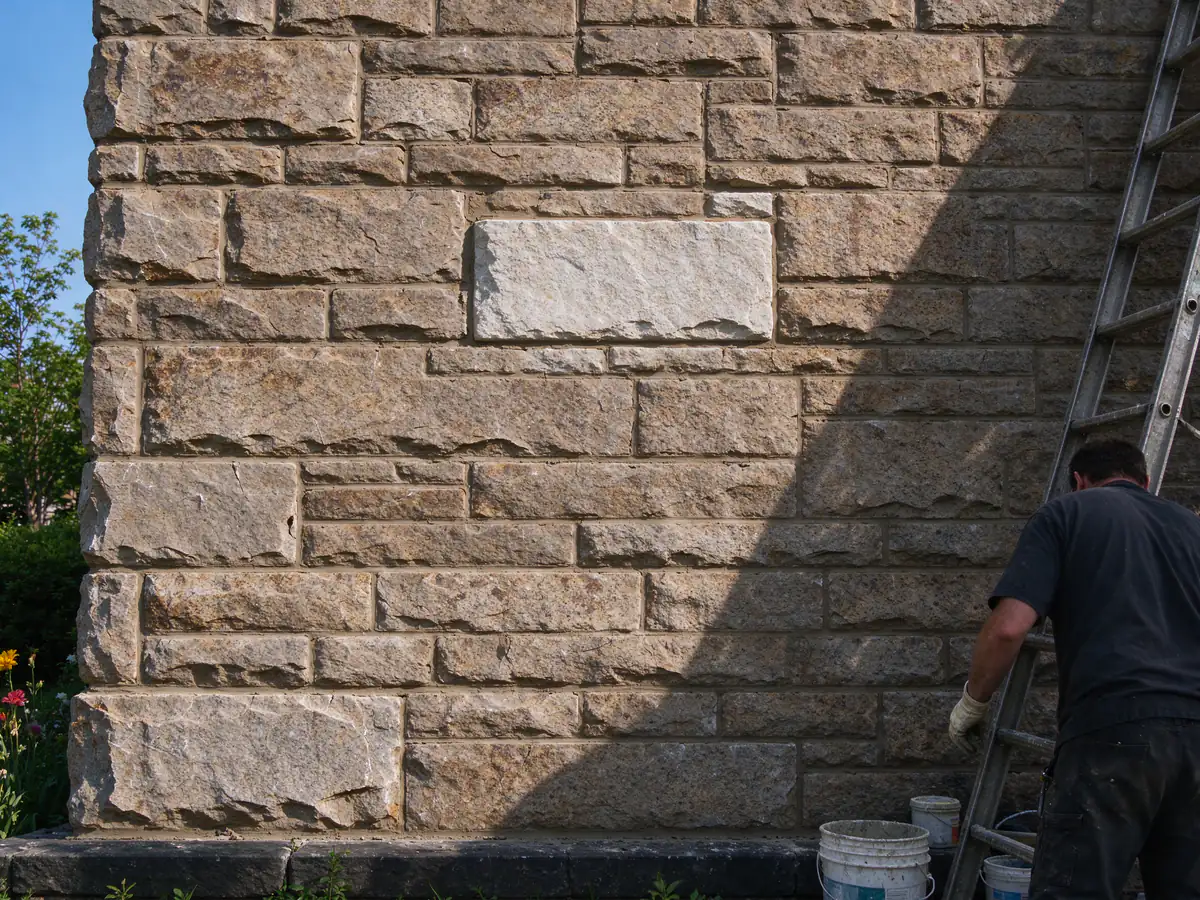
Representative photos of this type of work, not photos of specific completed jobs.