
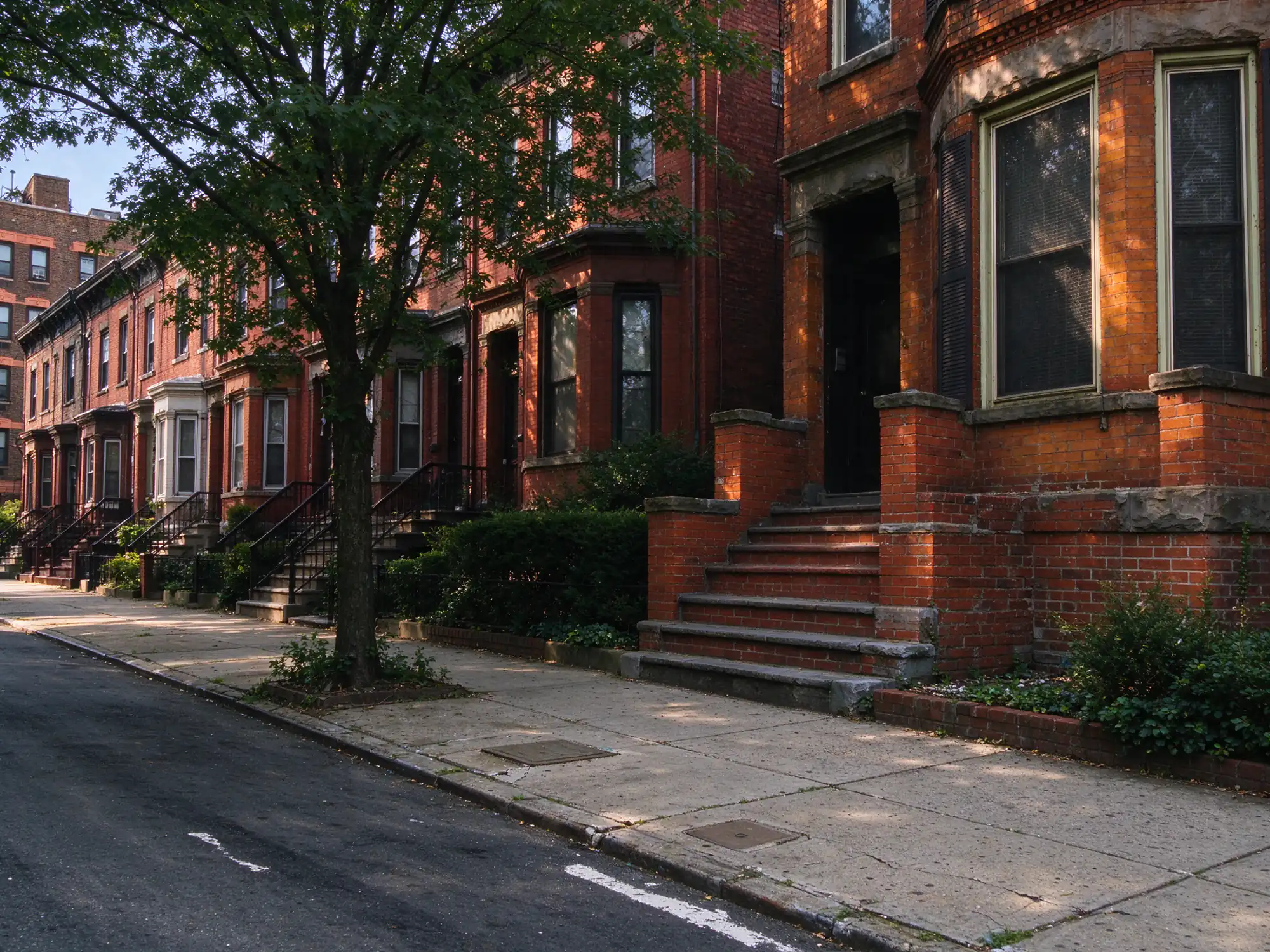
True Course Masonry Newark repairs brick walls, stoops, chimneys, lintels and parapets in Elizabeth, through licensed and insured contractors, on jobs of every size. Elizabeth is a city of prewar two-family and small multi-family houses: U.S. Census Bureau American Community Survey figures for 2020 to 2024 show 47.4% of its housing units in buildings of two to four units, 26.6% built in 1939 or earlier and 54.0% before 1960. Elizabeth has no local historic commission to catch an unsuitable repair, so the choice of mortar, brick and method rests with the owner.
No commission, so matching is the owner’s call
Elizabeth has a long National Register list, from Boxwood Hall and the Belcher-Ogden House on East Jersey Street to the Mid-Town Historic District, listed in 1995. No local historic preservation commission was found. In 2021 Preservation New Jersey placed the city on its list of most endangered historic places, urging a preservation ordinance and commission and noting that the lack of protection had already cost buildings architectural features. National Register listing alone does not put private repairs under review.
For an owner, that means no one will stop a repair that does not suit the building. A gray, hard cement mortar smeared over soft old joints, replacement brick that is the wrong color or size, or a stoop rebuilt in a different material will all pass without comment and can shorten the life of the wall. The guide to matching mortar and brick explains what a matched repair involves and why the mortar should be the weaker partner.
Midtown brick and terra cotta
The National Register nomination for the Mid-Town district describes nearly all of its buildings as masonry, with brick the principal material, often combined in early twentieth century buildings with cast stone or terra cotta facing and trim, and stone reserved for important civic buildings such as the 1931 Union County Courthouse. Most are two to four story commercial blocks with apartments over shops.
Mixed fronts like these need separate thinking for each material. Terra cotta and cast stone trim fail differently from brick, and steel lintels over shop windows and upper windows rust and expand, cracking the brick above; the guide to cracks above windows explains how to read that pattern. Parapets on flat-roofed blocks take weather from both sides.
Services for Elizabeth buildings
Brick pointing and brick repair cover the walls of two-family houses and small apartment buildings. Stoop repair handles brick and stone front steps, which settle and lose their joints on busy streets; the guide to stoop repair cost explains what drives the price. Chimney repair covers stacks, crowns and brick replacement, while flue liners and sweeping are not offered.
On Midtown and mixed-use buildings, lintel replacement and parapet repair deal with the two places brick fronts most often fail, and commercial masonry repair covers storefront and apartment buildings.
Two-family houses and shared masonry
With almost half of Elizabeth’s housing in two to four unit buildings, much of the city’s masonry belongs to houses where one structure serves more than one household. A single front stoop may lead to two entries, a chimney may vent two heating systems, and a foundation wall carries both floors. That changes how a repair is judged: a loose stoop tread or an open joint at a shared entry affects everyone who uses it, and a chimney’s condition matters to both units’ heat.
It also changes access. Side yards between Elizabeth’s older houses are often narrow, so the reach to a side wall or a rear chimney can decide whether a ladder, roof staging or scaffolding is needed, and that is one of the biggest drivers of cost on any masonry job. Photos of the side passages as well as the front help a first look plan access before anyone arrives.
Flooding along the Elizabeth River
FEMA’s flood maps show most of Elizabeth outside the high-risk zones, with pockets inside them along the Elizabeth River, near Morses Creek in the south and along the Newark Bay edge. On September 1, 2021, the remnants of Ida sent the Elizabeth River into an apartment complex, with water reported eight to ten feet deep, and four residents died.
Water that stands against a brick wall or foundation soaks into the brick and the mortar. As it dries, salts come out as a white bloom, which the guide to efflorescence explains, and mortar that was already soft can wash out of the lowest joints. After a flood, the work starts with letting the wall dry and finding what moved, then repointing and replacing damaged brick. Anything that suggests the foundation shifted is a question for an engineer first.
How an Elizabeth job is planned
A first look records the brick and mortar, joint depth, earlier repairs, lintels and parapets where present, how water reaches the wall and any movement, and, on a two-family house, which unit’s windows and entry fall in the work area. NOAA’s 1991 to 2020 normals for Newark Liberty Airport, a few miles away, record about 65 days a year when the low falls to freezing and the high climbs above it, so open joints and cracked crowns are fixed before winter where possible.
Permits come from the Bureau of Construction at City Hall, 50 Winfield Scott Plaza. N.J.A.C. 5:23-2.14 requires a permit to repair or reconstruct a structure unless an exception applies, and New Jersey requires home improvement contracts over $500 to be in writing with the contractor’s registration number. Owners near the Newark line can also see the Ironbound and Irvington pages.