
True Course Masonry Newark repairs chimneys, front steps, brick walls and stone trim on Bloomfield houses, and the work is carried out by licensed and insured contractors. As a masonry contractor for Bloomfield, NJ, the business takes jobs of every size, from a single loose brick on a porch pier to repointing a chimney from the roofline up. On a detached house the question is usually narrower than a facade program: deciding which part of the house to fix first, and whether that piece can be fixed on its own without opening the rest. This page works through that order using the township’s housing figures and the way each part of a house takes weather.
What Bloomfield’s housing figures point to
U.S. Census Bureau American Community Survey estimates for 2020 to 2024 count 21,789 housing units in Bloomfield. Of those, 64.0% were built before 1960 and 37.7% in 1939 or earlier. The building form is mixed but leans toward the single house: 41.1% of units are one-unit detached homes, 28.0% sit in two- to four-unit buildings and 27.2% in buildings of five or more. For comparison, only 12.6% of Newark’s units are detached.
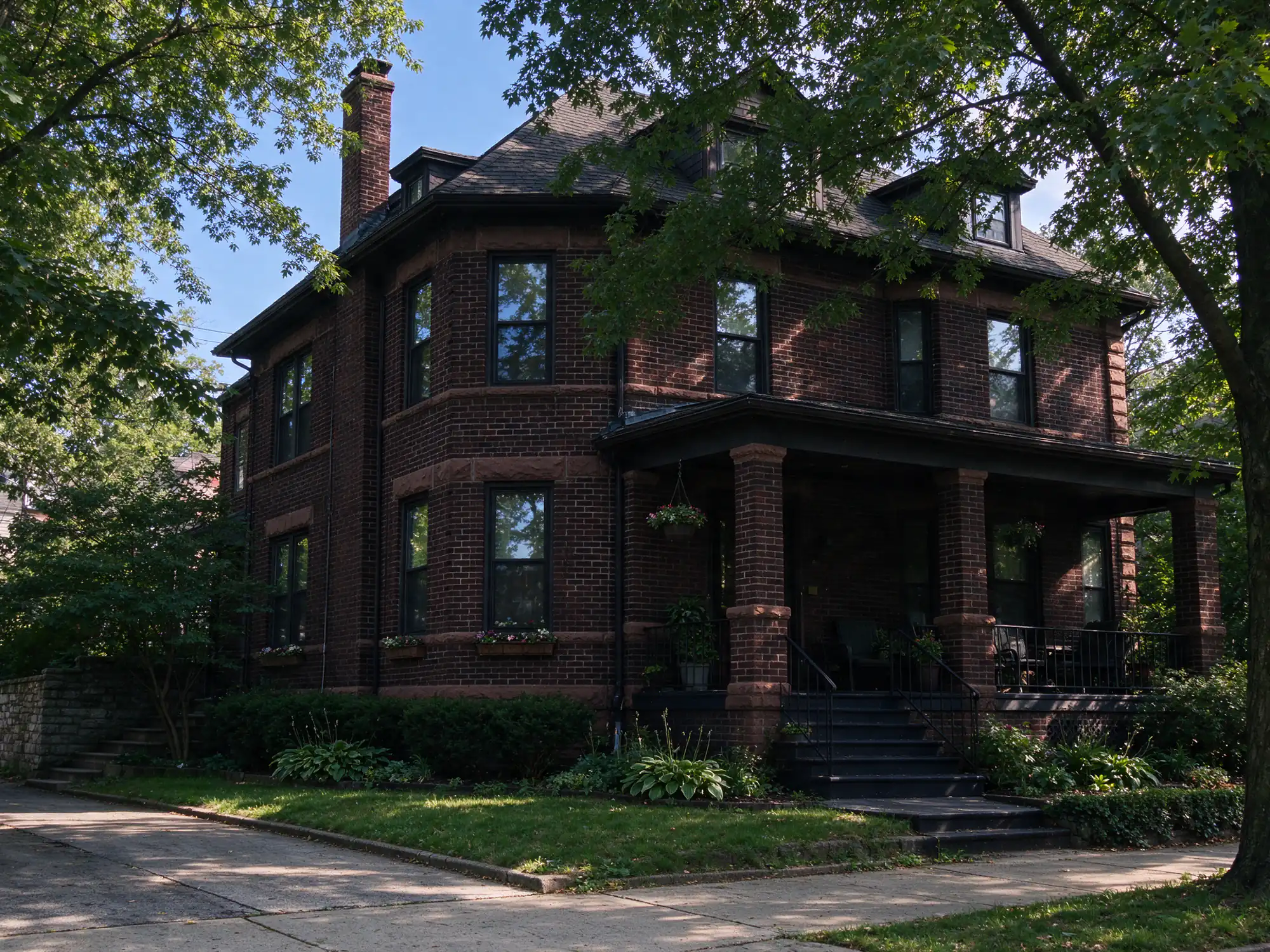
A detached house exposes all four of its walls, carries its own chimney where one was built, and usually meets the street with steps or a porch. The ACS records neither wall material nor chimneys, so these figures describe the likely shape of the stock, not any one address. They do explain why Bloomfield masonry questions tend to arrive one element at a time: a chimney, a set of steps, a foundation course at grade.
There is also a stone thread running through the area. The Newark Public Library’s history of Newark brownstone, a red-brown sandstone of the Passaic Formation, records quarrying from about 1700, and as late as 1881 three operations near Bloomfield Avenue were still cutting stone for buildings in Newark, New York City, Princeton, Albany and New Haven. Those quarries closed as the city grew north, and the NJ Geological Survey notes the stone fell out of favor. Where an older Bloomfield house or storefront has brownstone sills, steps or trim, replacement stone cannot be ordered from the original source, which is why the guide to brownstone repair and matching starts with the options for patching, reusing or substituting stone.
Deciding what to fix first on a Bloomfield house
The chimney is usually the most exposed masonry on a detached house, because the part above the roof is wet on all four faces and on top. NOAA’s 1991 to 2020 normals for Newark Liberty Airport, the nearest long-term station, show 79.9 days a year with a low at or below freezing but only 14.5 days with a high that stays below it, so roughly 65 days cross the freezing mark, alongside 31.5 inches of normal snowfall. That is a proxy, not a measured cycle count. Water that gets past a cracked crown or open joints near the top can freeze inside the brick, and the damage spreads downward from there. A chimney with loose brick or a visible lean is a falling hazard and is not something to push on or climb to check; the guide to choosing between a chimney rebuild and repointing covers how that call gets made.
Front steps come next for many owners, for a different reason. Treads hold standing water and meltwater, and New Jersey’s state highways alone took 238,480 tons of salt in winter 2021 to 2022, according to NJDOT, so salt-laden slush on walks and steps is a reasonable expectation even though no Bloomfield figure exists. Salt and freezing water attack mortar and brick faces at the treads first. If the base of a stoop has settled, though, repointing the joints only hides the movement for a season. The stoop repair cost guide explains how settlement and drainage change the price.
The lowest courses of the house are the third pressure point. Where a foundation wall shows above grade in brick or stone, those joints stay damp longer than the wall above, especially under a short downspout or where soil slopes toward the house. White deposits there are a moisture and salt symptom, explained in the guide to efflorescence on brick, not proof that the foundation is failing. Structural foundation repair and basement waterproofing are not offered; when cracks at grade suggest the house itself is moving, the guide to when a masonry crack needs an engineer sets out the warning signs.
Masonry services matched to Bloomfield homes
Chimney repair covers repointing, replacing spalled brick and crown work on the masonry above and below the roofline. Flue liners, sweeping and chimney inspections are not offered.
Chimney rebuild applies when the top courses have lost too much brick or mortar to repoint, or when a stack has started to lean. It needs a permit, and its price is set by height, roof access and how far down sound masonry begins.
Stoop repair handles brick and stone steps, loose caps and failed treads, with attention to what is under the steps before joints are touched.
Brick pointing means cutting out failed mortar to a sound depth and repacking the joint, not spreading new mortar over old. On a wall of mid-century or older brick, the mix is chosen to suit the brick rather than defaulting to the hardest mortar available.
Brick repair replaces individual units that have lost their faces, such as at a porch pier or beside a downspout, where matching size and color sets most of the work.
Stone masonry repair covers brownstone and other stone sills, steps and trim, where the stone’s bedding and softness decide whether a patch, a reset or a replacement piece is the right repair.
How a Bloomfield job usually runs
A first look checks the wall type where it can be seen, joint depth, brick and stone condition, earlier repairs, likely water sources, movement clues and the access the job will need. Prices come from that visit, and a written scope names the areas and the access before anything is scheduled.
Permits run through Bloomfield’s own construction office, not Newark’s. Under N.J.A.C. 5:23-2.14, repairing or reconstructing a structure needs a permit unless an exception applies, and the state’s ordinary-maintenance list contains no repointing item. Because so much of Bloomfield is one- and two-family housing, the state’s minor-work path in N.J.A.C. 5:23-2.17A often describes the job: notice before work starts, a permit application within five business days, and an inspection. New Jersey’s 2024 code editions took effect on August 17, 2026, with a reported grace period. Which path a given job takes is confirmed with Bloomfield’s construction office for that address.
On site, surfaces such as walks, plantings and windows are protected, failed material is removed to sound limits with dust control, and a trial area is used where color matters. Mortar needs time above freezing to cure, and NOAA’s median first fall freeze at Newark falls on November 10, which is why the guide to masonry work in cold weather matters for autumn jobs. The work finishes with cleanup and a walkthrough. New Jersey law requires home improvement contracts over $500 to be in writing with the contractor’s registration number and insurance certificate; the guide to hiring a masonry contractor in New Jersey lists what else to check.
Bloomfield owners near the township line can also read the pages for Belleville, Glen Ridge and Montclair.