
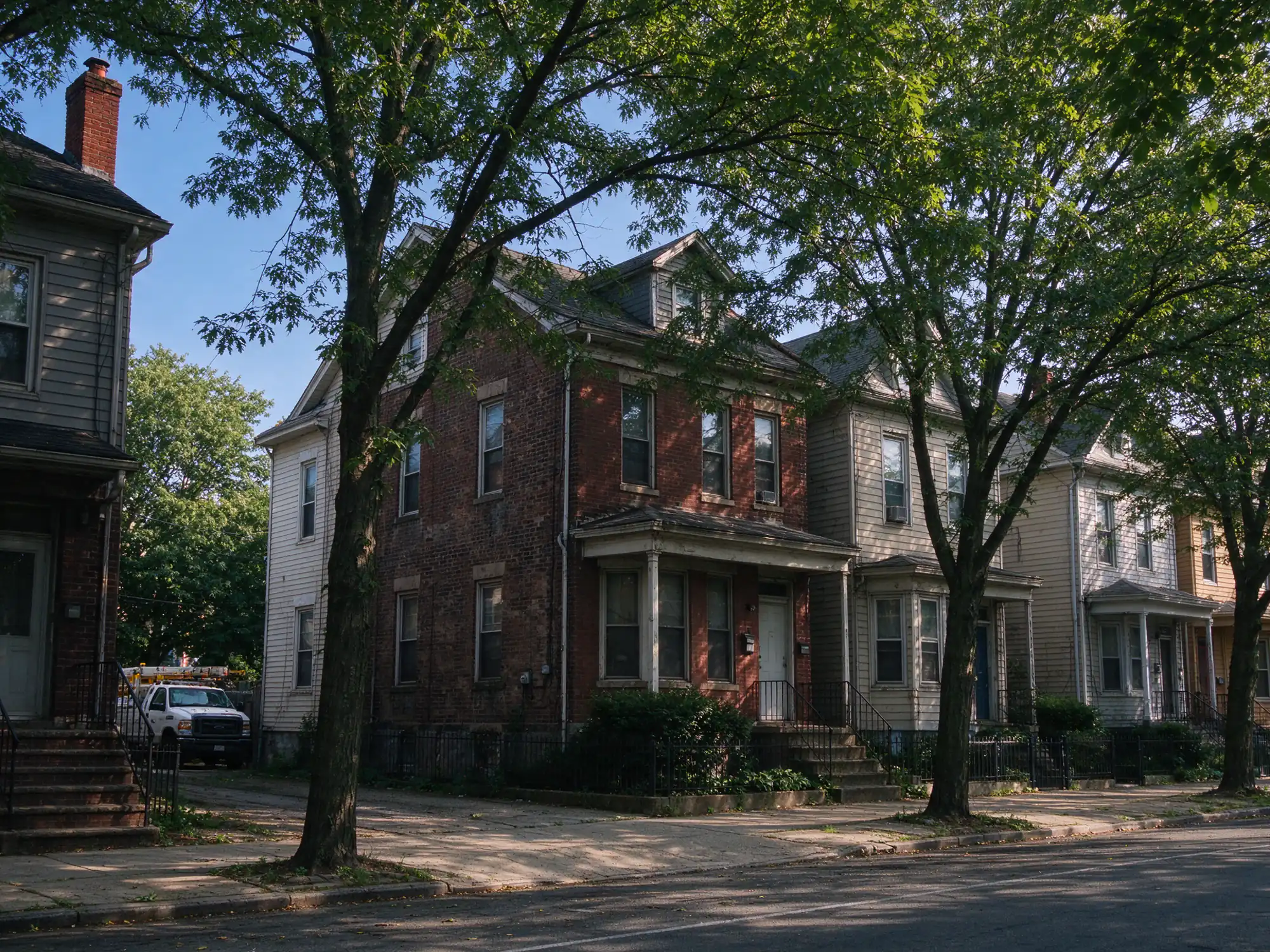
True Course Masonry Newark repairs brick walls, stoops, chimneys and block on Irvington houses and apartment buildings. Owners searching for a masonry contractor in Irvington, NJ usually have a specific piece of the building in mind, and the work is fulfilled by licensed and insured contractors who take jobs of every size, from one cracked step to repointing a whole brick elevation. On many Irvington properties the harder question is which parts are masonry at all, and which to fix first.
Why Irvington houses raise a sorting question first
Irvington borders Newark to the east and shares much of its building form. U.S. Census Bureau American Community Survey figures for 2020 to 2024 count 25,155 housing units, and 38.5% of them sit in buildings with two to four units, close to Newark’s 40.6%. Another 38.2% are in buildings of five or more units, and only 18.2% are detached houses. About 49.3% of the stock was built before 1960, and 24.4% in 1939 or earlier.
The ACS does not record wall material, so those figures cannot say how many buildings are brick, but they describe a township of multi-family houses that can be masonry in some places and frame in others. Where a two-family house is sided above a brick or block base, the masonry sits at the edges: the stoop, the chimney, the exposed base and any entry piers. Where an apartment building is brick-faced, the whole envelope is masonry and the questions move up the wall.
That split changes the first decision: an owner who knows which parts are masonry can call the right trade first.
Matching the problem to the right service
Stoop repair covers brick and stone front steps, treads, risers and caps. Settlement, drainage, deicing salt and freeze-thaw can all move a stoop, so repointing alone is not offered as a fix for one that is shifting.
Chimney repair covers the masonry stack: open joints, loose or spalled brick and crown work. Flue liners, sweeping and appliance work belong to other trades and are not offered.
Brick repair handles localized replacement where a section of face brick has lost its surface or cracked. On brick-faced buildings, the guide to matching mortar and brick explains why an exact color match on older brick is not always possible.
Block wall repair applies where a garage, a rear wall or an exposed base is built of concrete masonry units. Block uses control joints rather than the expansion joints a brick wall needs, and neither should be filled with mortar.
Lintel replacement comes up on brick apartment buildings with rows of openings, where a rusting steel angle can lift the brick above a window.
How an Irvington job is scoped and permitted
A first look checks the wall type wherever it can be seen, joint depth and brick condition, earlier repairs, likely water sources, movement clues and the access the job will need. On a mixed frame and masonry house, it also notes where the masonry ends and the frame begins, because water running behind siding can show up as damage at the brick or block below it. Prices come from that visit, and the written scope names each area and how it will be reached.
Permits run through Irvington’s own construction office. Under N.J.A.C. 5:23-2.14, repairing or reconstructing a structure needs a permit unless an exception applies. Stoops are treated differently from walls in the state rules: the ordinary-maintenance list in 5:23-2.7 includes repairing part of a stoop that does not support a roof with identical or closely similar materials, and the minor-work list in 5:23-2.17A covers total replacement of such a stoop, with notice before work and a permit application within five business days. Wall repointing appears on neither list. New Jersey’s 2024 code editions took effect on August 17, 2026, with a reported grace period. Each job is confirmed with the Irvington office before work starts.
What makes Irvington different from its neighbors
The housing mix is the clearest local factor. Irvington’s split between two- to four-unit buildings and larger apartment buildings is close to even, which is unusual among the nearby towns: East Orange is dominated by buildings of five or more units, while Maplewood is 60.9% detached houses. A single Irvington block can therefore hold a sided two-family with a brick stoop next to a brick apartment building with a parapet, and the two need different scopes.
Age is the second factor. Roughly half of Irvington’s units predate 1960, and NOAA’s 1991 to 2020 normals for Newark Liberty Airport, the nearest long-term station, record 79.9 days a year with a low at or below freezing and 14.5 days with a high that stays there, about 65 days that cross the freezing mark. That is a proxy, not a measured cycle count. On a stoop, which takes rain and shoveling salt on its treads, those crossings work on saturated brick and mortar at the main entrance.
Permit data is thin. The NJ Department of Community Affairs Construction Reporter shows $0 in Irvington residential alterations for 2024, which looks like a reporting gap, so this page makes no claim about how common any repair is locally.
Why this approach suits Irvington owners
Scopes are written to the part of the building that needs work, so a failing stoop gets a stoop scope, not a repointing program for a wall that is mostly siding. Small repairs are welcome. New Jersey law requires home improvement contracts over $500 to be in writing with the contractor’s registration number and insurance certificate, and the guide to hiring a masonry contractor in New Jersey lists what else belongs in that contract. The brick repair cost guide explains what moves a price, and the guide to stair-step cracks in brick explains why a crack pattern alone never proves one cause. Owners across the township line can see the Orange page as well.